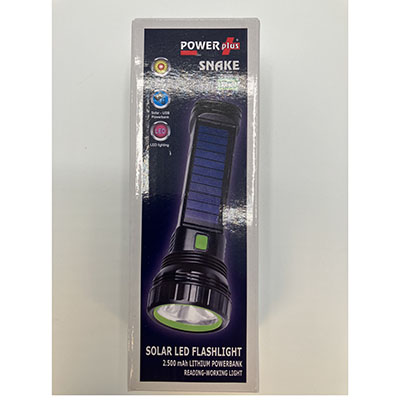
POWER PLUS — SNAKE Solar LED flashlight
Black solar LED flashlight. Product sold online.

⚖️ Acties bevolen door autoriteiten
- ▸ Measures ordered by economic operators (to: Distributor) Withdrawal of the product from market
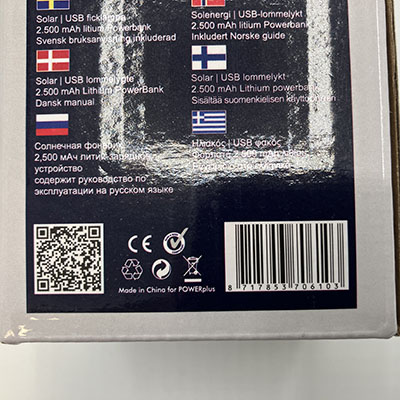
8717853706103
What is this? This is a small LED flashlight that runs on sunlight. The wire that connects it to the light has plastic that may be unsafe.
What's happening? The plastic in the wire has too much of three bad chemicals. These can harm people and the earth.
Does this affect me? If you own this flashlight in Sweden or Poland, it may put you at risk.
What should I do? Stop using it right away. Ask a pharmacist or doctor if you feel sick.
🤖 Deze begrijpelijke samenvatting wordt automatisch gegenereerd vanuit de officiële mededeling van de instantie met behulp van AI. Het is uitsluitend bedoeld voor algemene informatie — niet als medisch advies. Raadpleeg voor beslissingen over uw gezondheid altijd een apotheker of arts en lees de officiële bron hieronder.
🔬 Medische / technische details voor professionals
Risk level: Serious risk · Type: Chemical, Environment · Category: Lighting equipment · Hazard: The plastic material of the cable has excessive concentrations of bis(2-ethylhexyl) phthalate (DEHP), dibutyl phthalate (DBP) and short chain chlorinated paraffins (SCCPs) (measured values: up to 0.46%, 0.23% and 2.0% by weight, respectively). These phthalates poses a risk to human health and the environment. SCCPs persist in the environment, are toxic to aquatic organisms at low concentrations and bio-accumulate in wildlife and humans, posing a risk to human health and the environment. Prolonged exposure to them through the skin may cause cancer. · Origin: People's Republic of China
Alle informatie op deze pagina komt van de officiële mededeling van de instantie. Wij vertalen en vatten deze samen; wij voegen geen feiten toe of wijzigen deze.