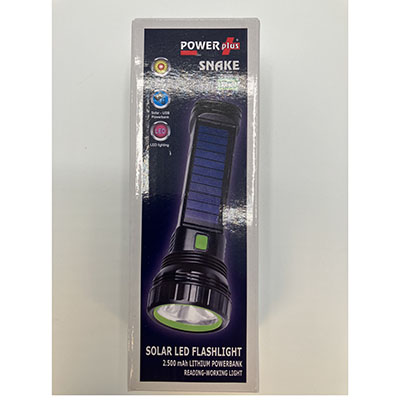
POWER PLUS — SNAKE Solar LED flashlight
Black solar LED flashlight. Product sold online.

- Risk level
- Serious risk
- Tipo
- Chemical, Environment
- Categoria
- Lighting equipment
- Origin
- People's Republic of China
Hazard: The plastic material of the cable has excessive concentrations of bis(2-ethylhexyl) phthalate (DEHP), dibutyl phthalate (DBP) and short chain chlorinated paraffins (SCCPs) (measured values: up to 0.46%, 0.23% and 2.0% by weight, respectively). These phthalates poses a risk to human health and the environment. SCCPs persist in the environment, are toxic to aquatic organisms at low concentrations and bio-accumulate in wildlife and humans, posing a risk to human health and the environment. Prolonged exposure to them through the skin may cause cancer.
⚖️ Azioni ordinate dalle autorità
- ▸ Measures ordered by economic operators (to: Distributor) Withdrawal of the product from market
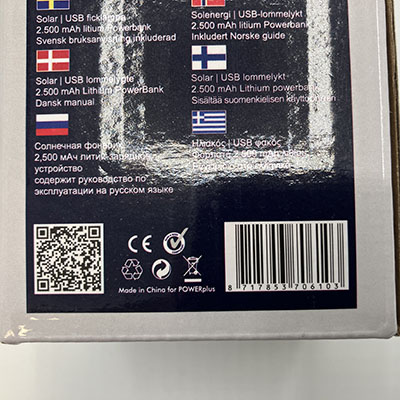
8717853706103
What is this? This is a small LED flashlight that runs on sunlight. The wire that connects it to the light has plastic that may be unsafe.
What's happening? The plastic in the wire has too much of three bad chemicals. These can harm people and the earth.
Does this affect me? If you own this flashlight in Sweden or Poland, it may put you at risk.
What should I do? Stop using it right away. Ask a pharmacist or doctor if you feel sick.
🤖 Questo riassunto in linguaggio semplice viene generato automaticamente dalla notifica ufficiale dell'agenzia tramite IA. È solo a scopo informativo generale — non è un consiglio medico. Per decisioni relative alla tua salute, consulta sempre un farmacista o un medico e leggi la fonte ufficiale collegata di seguito.
🔬 Dettagli medici/tecnici Per professionisti
Risk level: Serious risk · Type: Chemical, Environment · Category: Lighting equipment · Hazard: The plastic material of the cable has excessive concentrations of bis(2-ethylhexyl) phthalate (DEHP), dibutyl phthalate (DBP) and short chain chlorinated paraffins (SCCPs) (measured values: up to 0.46%, 0.23% and 2.0% by weight, respectively). These phthalates poses a risk to human health and the environment. SCCPs persist in the environment, are toxic to aquatic organisms at low concentrations and bio-accumulate in wildlife and humans, posing a risk to human health and the environment. Prolonged exposure to them through the skin may cause cancer. · Origin: People's Republic of China
Tutte le informazioni su questa pagina provengono dal comunicato ufficiale dell'agenzia. Le traduciamo e le riassumiamo; non aggiungiamo né modifichiamo i fatti.